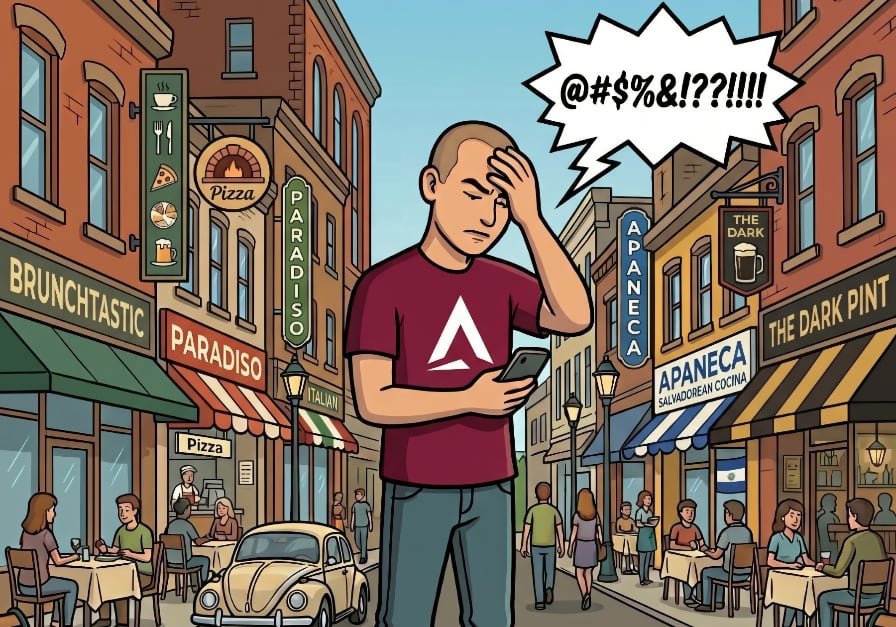

I’m going to be brutally honest with you. There are far too many restaurant websites out there that are literally a recipe for lost business.
My wife and I are big foodies. We absolutely love exploring the local YEG food scene, and we’re always on the hunt for our next favourite spot. But there is one key barrier that will consistently stop us in our tracks before we even leave the house: a bad website experience.
Let’s begin by discussing some of the top restaurant website fails that I encounter all the time in Edmonton.
Top Restaurant Website Fails
Restaurants with No Website
I’ve honestly been pretty shocked by how many times I’ve stumbled across a restaurant and been interested in checking it out, only to discover that they don’t even have a basic website!
Maybe I drove by the place one day and it caught my attention, or perhaps I was scouring through the online maps for a particular neighbourhood in Edmonton to look for some cool dining options beyond all of those boring corporate food franchises.
Either way, I manage to discover a new restaurant, and my next step is to visit their website, only to discover that they don’t have one! Sometimes their Apple or Google Maps listing includes a link to a completely broken URL, and sometimes the website field is blank.
Writing this article in 2026, more than 25 years after the internet became a mandatory part of modern business (“table stakes” if you’ll excuse the pun), a missing website honestly feels like a "Closed" sign for a new customer!
PDF Menus in a Mobile-First Online World
My next big restaurant website pet peeve is the widespread reliance on PDF menus. I get that this is a tempting option for many independent restaurateurs, because you can just upload the same PDF to your website that’s already been designed for your dine-in customers.
The problem is that more than 50% of the visitors to your website are going to be using their smartphone, which means that your potential customer gets stuck with a very subpar “pinch-and-zoom” experience when they’re trying to look at your restaurant’s menu.
This in turn means that your potential diners are probably going to get frustrated with the experience and shift their increasingly short attention spans to the next option, which is probably going to be your competitor’s website.
Punting Dine-In Customers Straight to Third-Party Delivery Websites
Food delivery service providers like DoorDash, SkipTheDishes, and Uber Eats are super common now, and despite the hefty fees they charge, lots of local restaurants still choose to partner with them.
The mistake that I commonly see though is that many smaller restaurants don’t even have their own website, and they instead punt all of their website visitors directly to a third-party online ordering service.
I would argue that this is a terrible choice for your brand, because you lose all control over the “look and feel” of the website, and it also does very little to encourage them to visit your brick-and-mortar location in person.
And which customer is more valuable for your business? Is it the dine-in customer that eats at your restaurant, buys your higher margin beverages, and tips you on the entire bill? Or is it the online delivery customer, who you’re immediately losing a 20% to 30% commission on to some faceless corporate tech giant?
Best Practices for Modern Restaurant Websites
Why put so much hard work, sweat, and capital into opening a restaurant, only to have potential customers stay away because your website sucks?
Conversely, what does a great restaurant website look like in practice?
Mobile-First Website Layout
As I mentioned earlier, more than 50% of your website visitors will be using their smartphone. Your website should load quickly, even when they’re on a dodgy mobile data connection while they’re away from their speedy home Wi-Fi, and it also needs to be carefully designed to look great on their phone.
Browser-Rendered Food and Drink Menus
No menu downloads. Just a clean, scrollable menu with item names, descriptions, and prices (if you choose to include those), with accessible typography that can be read on any screen size without a magnifying glass.
Curated, High-Impact Photos
You don’t need to bombard your potential customers with a huge gallery of photos, but your website should definitely include a photo or two of your restaurant, as well as some photos of your signature dishes.
The goal should be to provide your visitor with a flavour of what they can expect when they visit your establishment for the first time, including some fantastic photos of dishes that are guaranteed to get their stomachs rumbling!
Conclusion
Your food is high-quality. Your digital presence should be too! Don't let a “crappy” website be the reason a foodie chooses the place next door instead of yours.
Ready to Elevate Your Organization’s Technology?
Our services include:
- Search engine optimization
- Cost-effective web solutions
- Holistic systems design
- Custom full-stack web development
About the Author
John is a multi-disciplinary professional who has spent twenty years mastering the intersection of business, finance, and information technology. His technical journey began with building and repairing computers, a foundation that led to him being recruited by a pioneering video alarm monitoring startup as a network administrator and web developer. He subsequently attended the University of Alberta, discovering a passion for finance while completing his Bachelor of Commerce degree, and he later became a CFA charterholder.
He has over a decade of experience in the finance industry, including roles with Canada’s largest independent mortgage finance company, a highly successful private lender, and a boutique private equity firm. John also previously owned and operated a dedicated IT consulting practice, and he was the sole web developer and SEO specialist for an online media company that he co-founded.