
This may not be entirely surprising to you given that I’m an SEO consultant, but I usually make a point of doing a quick review of nearly all of the local small business websites that I come across.
Being based in Edmonton myself, these businesses are generally located in Edmonton as well, or surrounding areas, such as Sherwood Park, St. Albert, Nisku, and Leduc. I’ve met quite a few small business owners recently through in-person networking events, and these businesses range in size from just a solopreneur owner to businesses with a team of employees.
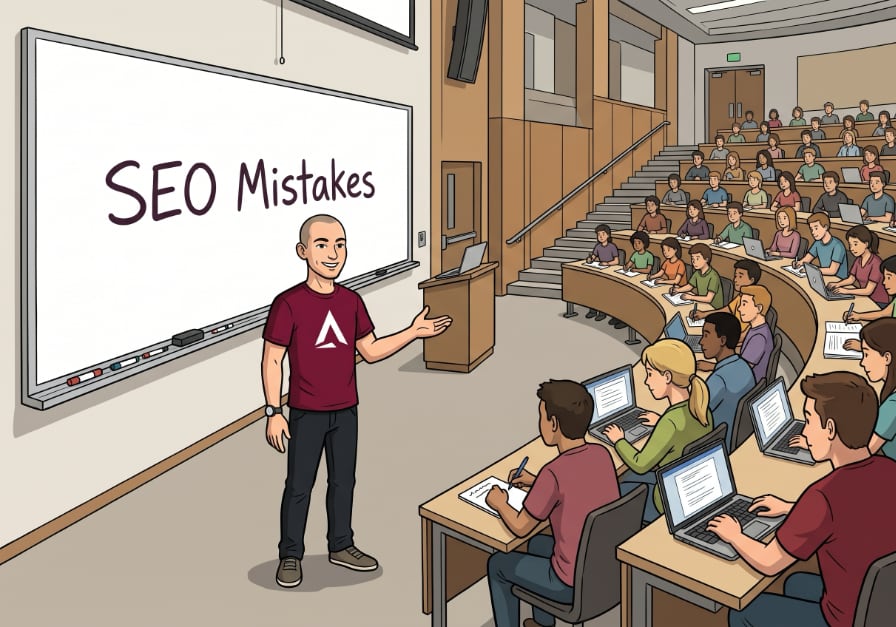
I have found that many of these small businesses are making one or more common SEO mistakes with their websites, and I’m going to be sharing a few of these with you in this article.
Failing to Clearly Communicate What Your Business Actually Does
The first SEO mistake that we’re going to cover is actually a combination of an SEO-specific problem and also a human-facing issue, which is when a business does a poor job of describing their products or services for both humans and search engines.
This may sound very basic to some readers, but I’ve personally seen countless websites with vague page titles and page headings like “About” or “Our Work” or “Building Things” instead of something very specific, such as “Dog Waste Cleanup” or “Dog Walking” services.
It’s unlikely that anyone is going to find you online if a search engine like Google doesn’t have a good understanding of what you do, and even the humans that do somehow manage to find your website may not realize that your services are perfect for them, because you’re doing a poor job of explaining what your services actually are!
Bookkeeper. Business Coach. Dog Walker. Accountant. Whatever it is that you do, always ensure that your website is crystal clear about it (e.g., Small Business Accountant).
Leaving Out Your Business Location and Service Area
Large, international businesses typically face some pretty steep marketing challenges. For example, imagine how difficult it is to stand out online if you’re selling yet another CRM system.
Small businesses also have to deal with plenty of competition locally, but they also have an advantage, because many of them only need to stand out within their local market. For example, do you think it’s easier for me to stand out for “Edmonton SEO Audits” or just “SEO Audits” in a Google search?
You’ll come across the term “Local SEO” quite a bit online, but a big part of this is actually very simple. Start by being clear about what your business offers, but also be sure to include where your business primarily offers those services (e.g., Sherwood Park Dog Waste Cleanup).
Making Basic On-Site Technical SEO Mistakes
When I’m working on an SEO audit for a client, one section of the audit is devoted to reviewing on-site technical SEO items, and two of those items are page titles and headings.
Page Titles
Each website page includes an HTML “title” element, which specifies the title for that specific page. This title appears in a variety of places, such web browser tabs, search engine results pages (SERPs), and if you share a web page URL with someone else via social media, e-mail, etc.
Page titles are hypothetically important for indicating to human users what a specific page is about, but they are even more important from an SEO perspective. To use our previous example, a home page with a title of “Sherwood Park Dog Waste Cleanup” is vastly superior to a home page with a title of “Home.”
SEO experts will typically put a surprising amount of thought and effort into choosing page titles, with some key goals:
- Clearly describing the purpose of a page (e.g., “Our Top 5 Favourite Poop Scoopers”)
- Keeping the length of the title to 60 characters or less, because SERPs only display so many characters before truncating the remainder of the title
- Ensuring that target keywords are included prominently in the title (more on this topic below)
- Trying to entice the user to actually click on the link
For example, the article that you’re currently reading primarily targets “SEO mistakes” as keywords, and title hopefully makes it clear that the content is particularly intended for small businesses that are interested in learning about what they may be getting wrong from an SEO perspective.
H1 and H2 Headings
Content section headings are important for human readers, but they are also very important for helping search engines to understand which chunks of text on your web page are more important than others.
Humans generally distinguish between headings and body text based on the appearance of a heading (e.g., larger, bolded text for a heading vs. normal text for a paragraph), but search engines rely instead on text being flagged with H1, H2, H3, etc. header tags.
I commonly see this type of issue with small businesses that have built their website with DIY site builders like Wix and Squarespace, with designs that make important text look like a header, but don’t correctly format that text as an actual HTML H1 or H2 header.

Publishing Low-Quality Content
Prior to the widespread adoption of AI tools created by companies such as Anthropic, Google, and OpenAI, there was actually a significant amount of demand for content writing services, and by that, I mean having actual humans writing content for you.
As with anything, the quality of that content varied significantly depending on how much money you paid someone to write the content, but at least it was still a human being writing it. Fast forward a few years though, and it became super cheap and easy to have AI write content for you instead.
For example, if you own a niche website with articles about a particular topic (e.g., dogs, personal finance, etc.), and you make money by attracting as many users to your website as possible and bombarding them with advertisements, you are incentivized to publish as much content as possible. More content hypothetically means more website visitors, and that in turn should hypothetically increase the advertising revenue that your website is generating for you.
This is also very tempting for Edmonton small business owners too, with the difference being that they are specifically hoping that publishing large amounts of AI-generated content will result in more potential customers for their businesses.
As you can guess, the proverbial dogs were unleashed, and many websites began mass-producing low-quality, AI-generated content. This worked for a bit, but as I write this article in the Fall of 2026, Google is keenly aware of this issue, and the company is already taking steps to identify and penalize websites that are doing this.
Google publishes comprehensive online documentation about Google Search, including some specific guidance about publishing generative AI content and spam policies. There has been some debate amongst SEO experts recently, because Google deliberately isn’t fully transparent about how it ranks (or chooses not to rank) content, but here are some key clues that are worth paying attention to:
- “Generative AI can be particularly useful when researching a topic, and to add structure to original content. However, using generative AI tools or other similar tools to generate many pages without adding value for users may violate Google's spam policy on scaled content abuse.”
- “You might find value in looking at the Search Quality Raters guidelines on how to evaluate both scaled content abuse (section 4.6.5) and main content created with little to no effort, little to no originality, and little to no added value (section 4.6.6).”
- “Examples of scaled content abuse include, but aren't limited to…using generative AI tools or other similar tools to generate many pages without adding value for users.”
These are just a few key quotes from the overall Google Search documentation about SEO, and some would argue that AI-generated content is still acceptable based on these guidelines, but my personal view is that high-quality, human-written content is the best approach.
Important side note for you as well. This article was written entirely by me, with minimal use of AI to help me with things like brainstorming ideas for how to word the headings. We’re all starting to get pretty good at telling when something has been written entirely by AI, and I’m confident that most people will read this article and be fairly certain that it was written by a person.
I also write articles like this to demonstrate my experience and technical expertise, and I think it’s clear that copying and pasting text from a chatbot doesn’t exactly align well with that goal.
Missing the Mark with Wording by Not Researching Keywords
One of the tricky things about writing content for a website is that the words we initially think of may not be the same words or phrases (i.e., keywords) that other people typically use when they are searching for information online.
For example, I offer both SEO and web development services, and for the latter, there are a variety of relevant keywords for me to be aware of (e.g., web design, web development, website builders near me, web agency, etc.). Each of these keywords also has its own estimated monthly search traffic and “difficulty” score, which is an indicator of how easy or difficult it is likely to be for your website to rank highly for a given keyword.
There are a number of professional SEO tools on the market for keyword research, and I can’t emphasize enough just how important keyword research is. Without keyword research, you are just guessing about which keywords to target, and while it’s possible that you may get lucky, keyword research significantly improves the probability that your small business will get noticed online.
Overlooking the Importance of Collecting Key Website Data
If your small business has a website, there are three free tools that you should be using to begin gathering data immediately, even if you aren’t ready to hire an SEO advisor yet, because a good SEO strategy requires an intentional, data-driven approach.
One of the first things that I ask a client for at the beginning of an SEO audit engagement is to provide me with access to some key data sources, including:
Google Analytics (or a privacy-friendly website visitor analytics alternative)
Google Search Console
Bing Webmaster Tools
Each of these tools has a different purpose, and I could write an entire article about each one, but overall, they help to ensure that your website is being properly indexed (i.e., found and included) by online search engines (e.g., Google, Bing, and others), and they also provide you with essential data about how many people are visiting your website.
More importantly, these data sources also tell you how people are finding you online, such as which specific queries you’re appearing for in Google searches, and which channels each website visitor is attributed to (e.g., paid advertising, social media, organic search, etc.).
If you haven’t already configured these tools, get going on this as soon as possible. Trust me, your future in-house marketing team or external advisor will tell you that I gave you the right advice!
Conclusion
For Edmonton small businesses, a website is still an essential foundation for your overall marketing strategy. Many business owners rely on a DIY site builder like Wix or Squarespace for their first website, and this isn’t necessarily a bad choice, but unfortunately many entrepreneurs are completely unaware that they are making some key SEO mistakes that are holding them back.
Having a website is a great start, but shouldn’t your website also be helping you with getting noticed online so that you can attract more customers?
Ready to Elevate Your Organization’s Technology?
Our services include:
- Search engine optimization
- Cost-effective web solutions
- Holistic systems design
- Custom full-stack web development
About the Author
John is a multi-disciplinary professional who has spent twenty years mastering the intersection of business, finance, and information technology. His technical journey began with building and repairing computers, a foundation that led to him being recruited by a pioneering video alarm monitoring startup as a network administrator and web developer. He subsequently attended the University of Alberta, discovering a passion for finance while completing his Bachelor of Commerce degree, and he later became a CFA charterholder.
He has over a decade of experience in the finance industry, including roles with Canada’s largest independent mortgage finance company, a highly successful private lender, and a boutique private equity firm. John also previously owned and operated a dedicated IT consulting practice, and he was the sole web developer and SEO specialist for an online media company that he co-founded.